Archives in PA: What You Can Find in Archives
Four examples of archival collections you can search in Pennsylvania, and the types of information you can obtain from them

There are millions of historical records online today. By typing in a few words into a search bar, we can instantly view links to thousands of possible results.
For genealogists this has been a boon to research. We can go back farther, faster than our parents and grandparents could ever dream.
But not every record of our ancestors is online and easily searchable. According to archivists, it never will be. For every historical document we can view online for an ancestor, there are hundreds to thousands of others in archival boxes around the country. Knowing how to research in archives is an important skill and archives are more accessible than ever.
This chapter will give four examples of archival collections you can search in Pennsylvania, and the types of information you can obtain from them.
Family Letters
Any family historian who received letters passed down in her family will tell you it is one of her most treasured items. If you are looking for letters from your family to others, it is possible there is an archive in Pennsylvania with them. But even if you find no family letters written by one of your ancestors, you may find your ancestors the topic of a letter.
Letters written between family members contained news, not only of the of the family itself, but also the news of what was happening in the community. This letter below was written by Sarah Knox to her brother William while he was in medical school.
In it, she tells of two events which occurred in the week prior to April 15, 1850, in Brownsville, PA.
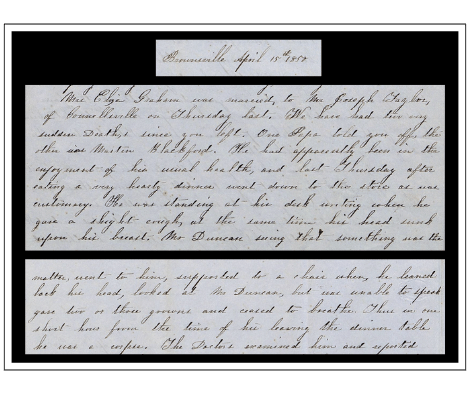
Here is the transcription of the part of the letter shown above:
Mrs. Eliza Graham was married to Mr. Joseph Taylor of Connellsville on Thursday last. We have had two very sudden deaths since you left. One Papa told you off [sic], the other was Mister Blackford. He had apparently been in the enjoyment of his usual health, and last Thursday after eating a very hearty dinner went down to the store as was customary. He was standing at his desk writing when he gave a slight cough, at the same time his head sunk upon his breast. Mr. Duncan seeing that something was the matter, went to him, supported to a chair when, he leaned back his head, looked at Mr. Duncan, but was unable to speak, gave two or three groans and ceased to breathe. There in one short hour from the of his leaving the dinner table, he was a corpse.
The level of detail Sarah provided was better than anything that would be found in a newspaper or vital record! If you have ancestors who lived in Brownsville in the 1850s, their lives may have been discussed in the letters of the Knox family.
Many such collections of family letters are preserved in archives around the state. The key to finding letters useful to your research is locating letters written from a particular time and place. Chapter 2: Creating Your Plan for Archival Research will help you focus your search. Even when you are not descended from the writers of letters, these family letters can reveal details of your ancestors that you will not find anywhere else.
Iron Furnace Time Books
One of the earliest industries in Pennsylvania was mining iron ore and casting it into household products. The workers would first create charcoal from trees over several weeks, then use that charcoal to power furnaces. Mined ore would be purified in the furnaces and cast into products such as stove plates, cookware, and rifle parts.
Iron production was labor intensive and each site, called a plantation at that time, had forty to two hundred workers. These men lived on-site, often in provided housing, with their wives and children. The owner of the iron-making facility was called the “iron master” and he employed a clerk to keep a series of ledger books tracking production, hours worked, and cost of goods sold.
The first iron furnaces began around 1700 and hit their peak production in the 1840s through 1860s with the War with Mexico and Civil War. They rapidly declined post-Civil War as coal-fired furnaces took over the processing of iron into steel products.
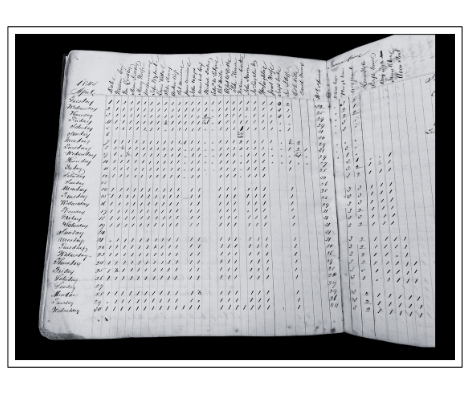
These iron furnace time books are helpful for genealogists tracking ancestors from the early 1700s through 1890. Each two-page spread of a time book lists the name of all the workers on-site and the days of the month in a grid. The images below are from the Centre Furnace in Centre County.
Each day a person worked is marked, so it is obvious when a worker is no longer employed at that location. This is like a daily census of this one small community.
The clerk also made notes alongside the grid to provide details on the workers. This is where a genealogist can get information on an ancestor, such as the type of work he did. The clerk also wrote about time off needed for weddings, funerals, and illness of family members. Prior to 1850, these are often the only record of marriage and death, besides church records.
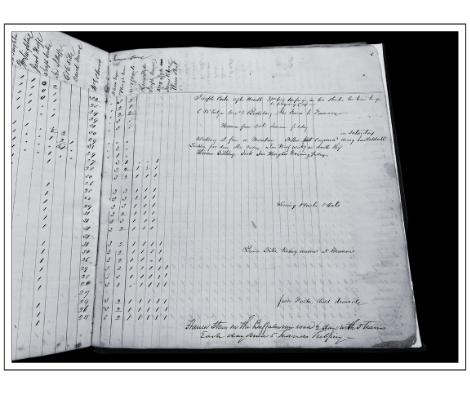
The information in iron furnace records gives a unique glimpse into both the work and personal life of our eighteenth and nineteenth century ancestors. Chapter 6: Regional Pennsylvania Archives and Chapter 7: State-Wide Archivesdiscusses where to find collections of these iron furnace records.
Store Keeper Ledgers
Every community in Pennsylvania had several stores where residents could buy household items. The store owner would track the purchases made by each individual, noting the item, cost, and date of purchase. These ledgers act as a type of constant listing of who lived in the area around the store. Below is an image from a page from the Pinegrove Mills Store in Centre County:
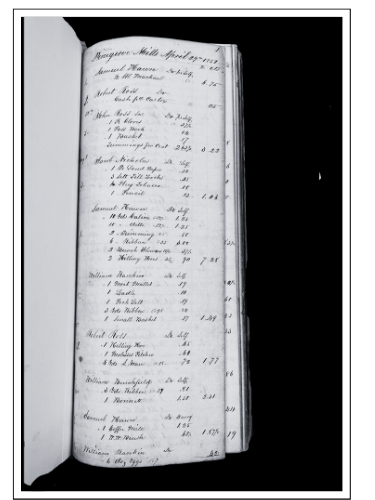
Examining what they purchased also provides a mental image of what their home looked like, what they wore, what they ate, and what daily life was like.
This is a transcription of the page image above. On April 29, 1851 the following people visited the store and purchased these items:
- Samuel Hawn – 1/2 bbl. Mackerel
- Robert Ross – Cash pd. Carters
- John Ross Sr. – 1 Pr. Gloves, 1 Pass Book, 1 Basket, Trimmings for a Coat
- Jacob Nicholas – 1 Dr. Sand Paper, 3 Sett Till Locks, 1 Plug Tobacco, 1 Pencil
- Samuel Hawn – 10 Yds. Calico, 10 Yds. Calico, 2 Yds. Trimming, 6 Yds. Ribbon, 2 Bunch Flowers, 2 Hilling Hocs
- William Rankin – 1 Meat Mallet, 1 Ladle, 1 Peck Salt, 3 Yds. Ribbon, 1 Small Basket
- Robert Ross – 1 Hilling Hock, 1 Molasses Pitcher, 4 Yds. S.Ware
- William Burchfield – 3 Yds. Ribbon, 1 Bonnett
- Samuel Hawn – 1 Coffee Mill, 1 W.W. Brush
- William Rankin – 6 doz. Eggs
Some of these items and measurements are known in the modern world, such as “Yds. Calico” for yards of calico fabric. Other items are completely foreign, such “W.W. Brush” and “Hilling Hock”. These provide opportunities for additional research and to learn more about how one’s ancestors lived.
Even if you do not find your particular ancestor, the information from store ledgers can fill in gaps of knowledge when writing a detailed family history. Chapter 3: Using Catalogs and Finding Aids will help you locate these records for your research.
Institutional Records
Institutionalizing people for mental or health reasons was normal in the nineteenth century and first half of the twentieth century. The names for these institutions included “lunatic asylum,” “insane asylum,” and “state hospital.” Pennsylvania hit peak population in its state hospitals in 1950, and many institutions closed in the 1980s. The records of the patients, or inmates as they were known then, are detailed and provide information of great interest for genealogical research and descendants.
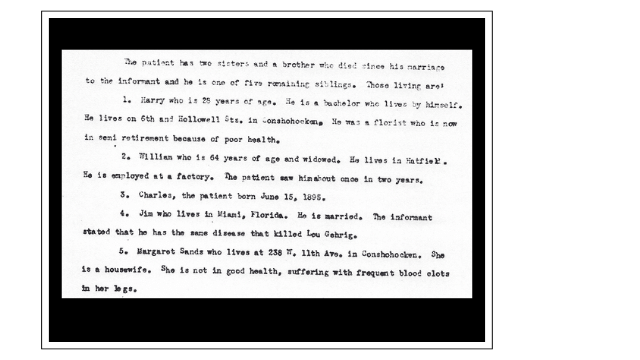
This Norristown State Hospital record from 1944 for Charles Geiger is over forty pages long.
One part details family interviews which provided information on all of Charles' living relatives. Their marital status, health status, location, and occupations are all listed. This kind of information is rare to find all in one place and is essential for tracing descendants of ancestors to match to shared DNA matches.
Other parts detail medical diagnoses for Charles which would be of interest to genetic descendants in the case of inheritable conditions. A physician noted that Charles had both Parkinson’s disease and several heart conditions. All of these can be passed to descendants.
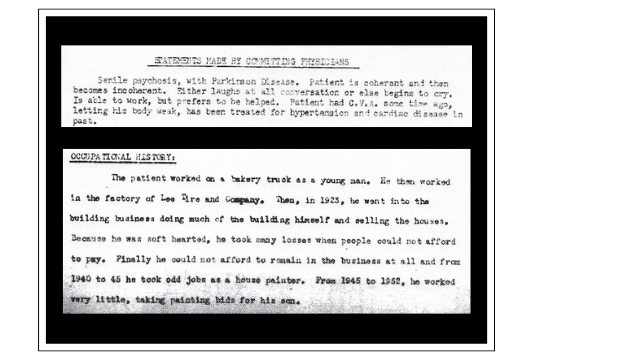
Charles' work history and all his employers are listed as well as what he liked to do for fun at night and weekends. A full picture emerges of what an individual’s day-to-day was like.
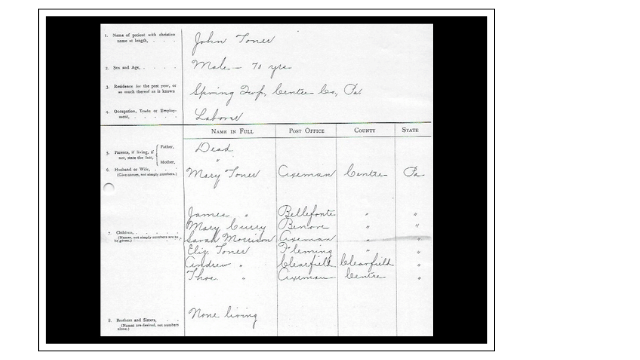
Records from the nineteenth century are not as detailed as the mid-twentieth century, but they still provide valuable genealogical information. This record of admission to the Danville State Hospital from 1893 for John Toner lists the name and location of his spouse (including the detail that they were separated at the time), and all his children.
It also notes that he has no living siblings and his parents are both deceased. Information like this is essential to distinguishing same named individuals and confirming family relationships in a time before birth certificates, death certificates, or marriage licenses.
The surviving state hospital records are stored at The Pennsylvania State Archives and are available by a research request by mail. Chapter 4: Researching in Archives in Person or From a Distance will help you in composing that mail-in request.
All the items shared in this chapter are only found in archives and are unlikely to ever be fully digitized and indexed on the internet.
Read on for how you can develop your plan to find archival materials to finish your family tree.
From the book Archives in Pennsylvania for Genealogy Research, 2nd edition, by Denyse Allen. Print and ebook copies available on Amazon https://www.amazon.com/dp/B0DQX915KK
© 2019–2026 PA Ancestors L.L.C. and Denyse Allen. All Rights Reserved.
About PA Ancestors: The authoritative resource for Pennsylvania genealogy research — vital records, county courthouses, archives, probate, land records, military records, and immigration research across all 67 Pennsylvania counties. Founded by Denyse Allen, Pennsylvania genealogy researcher and author.
More Pennsylvania Research: paancestors.com